ISO 9001:2026 is the latest version of the international Quality Management System (QMS) standard. It helps organisations consistently deliver high-quality products and services, meet customer expectations, and improve business performance.
The earlier version, ISO 9001:2015, is now being updated to reflect modern business needs such as risk management, sustainability, digital processes, and climate awareness. The 2026 update is not a complete rewrite but a practical upgrade that strengthens quality, efficiency, and long-term reliability.
ISO 9001:2026 applies to all types of organisations, regardless of size or industry, and supports continual improvement through structured processes and data-based decisions.
What Is ISO 9001?
ISO 9001 is a set of simple rules that helps a company do good work. It is called a Quality Management System (QMS).
It works like a step-by-step guide that shows a company how to stay organized, give good service, and keep customers happy. It tells everyone in the company what to do, how to do it, and how to fix things when something goes wrong. With ISO 9001, a company can check its work, reduce mistakes, and make better decisions. It also helps workers understand their roles clearly so they can do their jobs properly. When a company follows ISO 9001, it becomes more trusted, safer, and stronger over time. Think of it like a big plan that helps a company:
- Check their work
- Fix mistakes
- Make customers happy
- Improve every day
More than one million companies all around the world use ISO 9001. It works for shops, factories, hospitals, tech companies, schools—almost everywhere. The new ISO 9001:2026 keeps the main idea the same: Do good work and do it better each day. But it also adds new things for today’s world, like climate change, technology, and honest work.
Why Do We Need ISO 9001:2026?
The world has changed a lot since 2015. Today, we have more technology, smart tools, and artificial intelligence (AI). We also face big climate problems, new customer needs, and global supply chains. People care more about ethics and fair work. Because of these changes, companies need rules that fit the new world.
Companies need rules that fit this new world. So, experts from many countries worked together from 2021 to 2025 to update ISO 9001.
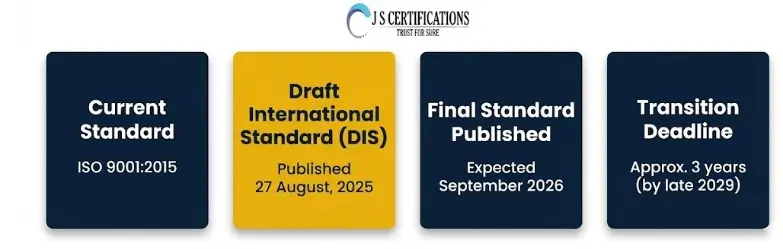
The Draft International Standard (DIS) came out in 2025. The final version will come in late 2026. Companies will get around three years to switch from the old version to the new one.
ISO 9001:2026 Timeline – What Businesses Need to Know
The ISO 9001 quality management standard is being updated to ISO 9001:2026, and organisations worldwide are preparing for the transition. The good news is that companies have enough time to plan, adapt, and upgrade their Quality Management System (QMS) without pressure.
Below is a clear breakdown of the ISO 9001:2026 timeline, transition period, and what it means for certified businesses
- 2025 → Draft version released
- 2026 → Final standard published
- 2027–2028 → New rules start in audits
- 3-year transition → Old ISO 9001:2015 certificates stay valid
- By 2029 → All companies must shift to ISO 9001:2026.So, there is enough time to prepare.
| Year | Event / Milestone | What Happened |
| 2015 | Last version ISO 9001:2015 | Companies follow older rules for quality. |
| 2021 | Update process started | Experts from many countries begin working on new ISO rules. |
| 2025 | Draft International Standard (DIS) released | The draft version of ISO 9001:2026 is shared for review. |
| Late 2026 | Final ISO 9001:2026 released | The new version is officially published. |
| 2026–2029 | Transition period | Companies have ~3 years to move from ISO 9001:2015 to ISO 9001:2026. |
Key Takeaway for Businesses
The transition from ISO 9001:2015 to ISO 9001:2026 is well-planned and business-friendly. With a 3-year transition window, companies have enough time to:
- Update documentation and processes
- Train teams on new requirements
- Align audits with the latest ISO 9001 standard
Early preparation ensures smoother audits, lower transition costs, and stronger quality management systems.
What Are the Big Changes in ISO 9001:2026?
The ISO 9001:2026 update is not a complete rewrite of the standard. Instead, it is a strong upgrade that adds clearer direction for modern business challenges. The focus is on making Quality Management Systems more sustainable, resilient, and future-ready.
Below are the key changes in ISO 9001:2026 that businesses should understand.
1. Climate Change Becomes an Important Requirement
For the first time, climate change is clearly recognised in ISO 9001:2026. Organisations are expected to consider climate-related risks and impacts while planning and managing their operations.
This includes:
- Waste generation and reduction
- Energy use and efficiency
- Environmental impact of processes
- Climate-related operational risks
By addressing these factors, organisations can reduce environmental harm, improve sustainability, and use resources more efficiently.
Why this matters:
This change helps businesses align with global sustainability goals, strengthen risk-based thinking, build customer trust, and stay prepared for future environmental regulations.
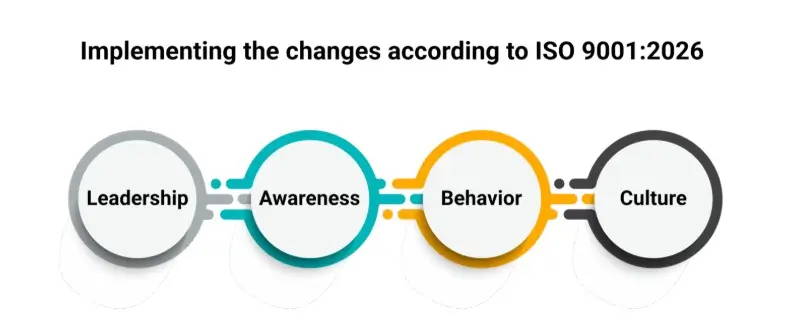
2. Leaders Must Build a “Quality Culture”
In ISO 9001:2026, leadership is not just about approvals and signatures. Leaders are expected to actively create a culture where quality is part of everyday work.
This means leaders should:
- Lead with strong values and honesty
- Promote fair and clear ways of working
- Guide and support teams to improve performance
- Encourage learning and new ideas
- Take responsibility for quality outcomes
When leaders show real commitment, employees follow the same mindset.
Why this matters:
Strong leadership builds trust, improves teamwork, reduces mistakes, and helps organisations deliver consistent quality while growing in a sustainable way.
Here’s your content rewritten in the same format, tone, and structure as the example you shared:
3. Risks and Opportunities Are Clearly Separated
In the updated ISO 9001:2026 structure, risks and opportunities are no longer combined. They are now treated as separate elements, making planning clearer and more effective.
The clauses are divided as follows:
- 6.1.1 Risks – identifying problems or threats that could negatively affect operations
- 6.1.2 Opportunities – identifying positive chances for improvement and growth
- 6.1.3 Actions – defining what steps the organisation will take to address risks and use opportunities
This clear separation helps organisations think more strategically instead of treating risks and opportunities as the same thing.
Why this matters:
By separating risks and opportunities, businesses can identify potential issues earlier, make better decisions, reduce surprises, and create practical action plans that support continuous improvement and long-term growth.
4. Increased Use of Technology and Data
ISO 9001:2026 highlights the growing importance of technology and data in modern business operations. Organisations are encouraged to use digital tools such as AI, smart software, machines, and data systems to improve quality management.
This includes:
- Monitoring and checking work processes
- Secure storage of records and information
- Tracking product and service quality
- Identifying errors and issues faster
By using technology effectively, organisations can improve accuracy, speed, and overall process reliability.
Why this matters:
Using technology helps businesses make better decisions, reduce human errors, improve efficiency, and maintain consistent quality in a competitive and fast-changing environment.
5. Strong Focus on Ethics and Fair Work Practices
ISO 9001:2026 places greater emphasis on ethical behaviour and fair working practices. Organisations are expected to operate with honesty, transparency, and responsibility.
This includes:
- Ethical business conduct
- Respect for employee rights and well-being
- Clear and open communication
- Building trust with customers and stakeholders
By following ethical practices, organisations create a positive and safe work culture.
Why this matters:
A strong ethical foundation improves employee satisfaction, strengthens customer confidence, protects the organisation’s reputation, and supports long-term business success.
ISO 9001:2026 will continue to follow the same main structure as the 2015 version, which means all the important clauses from 3 to 10 are still included. These clauses explain how a company should plan, manage, check, and improve its quality system. To make it easier to understand, here is a simple breakdown of what each clause means in easy English.
| Clause | Simple Meaning |
| 3 – Terms & Definitions | Explains important words used in the standard. |
| 4 – Context of the Organization | Know your company, customers, and risks. |
| 5 – Leadership | Leaders must guide the team and care about quality. |
| 6 – Planning | Plan goals, risks, and actions before starting work. |
| 7 – Support | Give people training, tools, and resources. |
| 8 – Operation | Do the real work precisely. |
| 9 – Performance Evaluation | Check results and see if work is good. |
| 10 – Improvement | Fix problems and make things better. |
Extra Small Updates
- Workers must know the company values
- Change management is clearer
- Supplier checks are stronger
- Customer communication improves
- Backup plans must be shared more clearly
How ISO 9001:2026 Helps Businesses
ISO 9001:2026 helps companies in many ways, and these actions bring useful benefits. It guides businesses to work better, stay organized, solve problems early, and use new technology the right way. Because of this help, companies become safer, faster, trusted, and more successful. The table below shows the difference between how ISO 9001:2026 helps and the benefits companies receive.
| How ISO 9001:2026 Helps (What it does) | Benefits for the Company (Good results) |
| Finds problems early with checks and tools | Fewer mistakes and safer work |
| Improves planning and reduces waste | Saves money and time |
| Makes rules clear for all workers | Stronger teams and better teamwork |
| Uses smart tech like AI and data systems | Faster work and smoother processes |
| Adds climate care and ethical rules | Better company image and more trust |
| Guides companies to fix issues quickly | Higher quality products and services |
| Gives clear steps for audits and updates | Easy certification and long-term success |
| Encourages daily improvement | Company grows stronger every year |
How to Get Ready and Apply for ISO 9001:2026
Getting ISO 9001:2026 is simple if a company starts early. You do not need to wait for the final version. Here are the steps to prepare and apply:
1. Understand the New Standard
Read the DIS version and learn what is changing. ISO 9001:2026 focuses on better work, customer trust, climate care, ethics, and smart technology.
2. Do a Gap Check
Compare your current QMS with the new rules. Find what is missing and what needs improvement.
3. Train Your Team and Leaders
Explain new topics like climate risks, ethical work, and new responsibilities. Make sure everyone understands their role.
4. Update Your Documents
Write or revise plans, policies, and controls to match ISO 9001:2026 requirements.
5. Add Useful Technology
Use smart tools or software to improve work, reduce mistakes, and track tasks.
6. Talk to a Certification Body
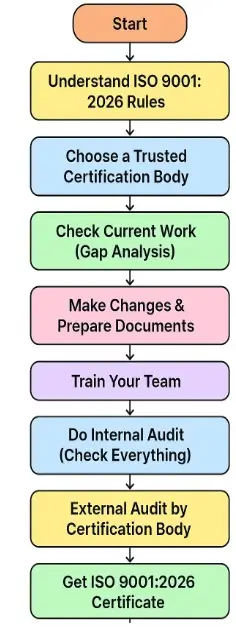
Choose a trusted and accredited certification body. Ask them how to shift from the old version to the new one.
7. Test Small Changes First
Start in one department. Fix any problems before applying changes everywhere.
8. Conduct an Internal Audit
Check everything inside your company. Find and fix mistakes before the official audit.
9. External Audit
Your certification body will visit the company and check if you follow ISO 9001:2026 rules.
10. Get Your Certificate
If you pass the audit, you receive the ISO 9001:2026 certificate. This proves your company works safely, honestly, and efficiently.
11. Keep Improving
ISO 9001:2026 is not a one-time job. Keep improving your work every day to stay trusted and successful.
Who Can Use ISO 9001:2026?
ISO 9001:2026 is applicable to every type of organisation, irrespective of size, industry, or location. The standard is built on a process-based and risk-based approach, making it suitable for businesses that manufacture products, deliver services, or manage complex operations.
Whether an organisation is a startup, MSME, large enterprise, government body, or service provider, ISO 9001:2026 provides a flexible Quality Management System (QMS) framework that can be tailored to specific business needs.
Industry-Wise Examples of ISO 9001:2026 Implementation
Manufacturing Sector (Toy Factory Example)
Manufacturing companies can use ISO 9001:2026 to:
- Control plastic waste and raw material usage
- Ensure product safety and regulatory compliance
- Train employees on quality procedures
- Use digital tools to monitor production, defects, and inventory
This results in better product quality, reduced rework, and improved sustainability.
Small Businesses & Retail Shops
Small businesses benefit from ISO 9001:2026 by:
- Standardising daily work processes
- Maintaining essential records and documentation
- Using customer feedback to improve services
This helps small organisations reduce errors, improve consistency, and compete with larger brands.
Healthcare Organisations (Hospitals & Clinics)
Healthcare providers can apply ISO 9001:2026 to:
- Reduce operational and clinical errors
- Improve patient safety and service delivery
- Use performance data for continual improvement
This leads to higher patient satisfaction and safer healthcare systems.
Financial Institutions (Banks, NBFCs, FinTechs)
Banks and financial organisations use ISO 9001:2026 to:
- Implement transparent and controlled processes
- Strengthen risk management and compliance
- Improve service reliability and customer trust
This supports strong governance and long-term credibility.
Why ISO 9001:2026 Works for Every Organisation
- Suitable for all industries and organisation sizes
- Enhances quality control and operational efficiency
- Strengthens risk-based thinking and decision-making
- Builds customer confidence and brand reputation
- Supports continual improvement and sustainable growth
ISO 9001:2026 is not limited to large corporations. Its scalable and adaptable structure allows even small businesses to implement effective quality management practices. Organisations that adopt ISO 9001:2026 gain better control, improved performance, and long-term trust from customers and stakeholders.
Final Takeaway
No matter what your business does or how big it is, ISO 9001:2026 fits everywhere. It helps organisations work smarter, reduce risks, improve quality, and build lasting customer confidence.
Real-Life Benefits of ISO 9001:2026
Companies that tested early versions and pilot practices aligned with ISO 9001:2026 have already reported measurable business improvements. These benefits go beyond compliance and directly impact daily operations and customer satisfaction.
Key Results Seen by Organisations:
- Up to 20% reduction in waste, leading to cost savings
- Faster customer support and issue resolution
- Fewer product and service errors, improving consistency
- Better teamwork and internal communication
- Stronger sales performance through improved quality and trust
- Higher customer confidence and brand credibility
Why These Benefits Matter
ISO 9001:2026 focuses on continual improvement, risk-based thinking, and efficient processes. Even small daily improvements, when applied consistently, create long-term operational excellence and sustainable business growth.
Final Thoughts
ISO 9001:2026 is not just a rule book. Companies that start preparing now will stay ahead of others. They will have happier workers, stronger teams, and loyal customers. It is a smart guide for any business to grow in a fast and changing world.
The new standard brings together:
- Quality
- Technology
- Climate care
- Honesty
- Good leadership
ISO 9001:2026 is the future of quality. And the future starts now.
If you want the process to be easy, fast, and professional, JS Certification is the best choice. They help with documents, audits, training, and smooth transition to the new 2026 version. With their expert team, companies can get certified without stress and follow every rule correctly. JS Certification makes the whole journey simple and worry-free.
FAQs:
-
What is ISO 9001:2026?
ISO 9001:2026 is the new update of the global quality management standard. It keeps the same structure as ISO 9001:2015 but adds clearer language, modern ideas, and stronger focus on quality culture.
-
Are Clauses 3 to 10 still included in ISO 9001:2026?
Yes. All main clauses (3 to 10) remain the same. Only small improvements and clarifications are expected in the 2026 version.
-
When will ISO 9001:2026 be officially released?
The new standard is expected to be published in late 2026, after Final Draft International Standard (FDIS) approval.
-
How long will companies get to transition to ISO 9001:2026?
Organizations will likely get a 3-year transition period, ending around late 2029, to fully shift from ISO 9001:2015 to ISO 9001:2026.
-
What are the main changes expected in ISO 9001:2026?
Only minor changes are expected, including better readability, stronger focus on quality culture, ethical conduct, and clearer expectations for trend analysis and performance.
-
How can businesses prepare for ISO 9001:2026 now?
Companies should start with a readiness review, train internal teams, refresh documentation, and follow updates from ISO committees to stay ahead.