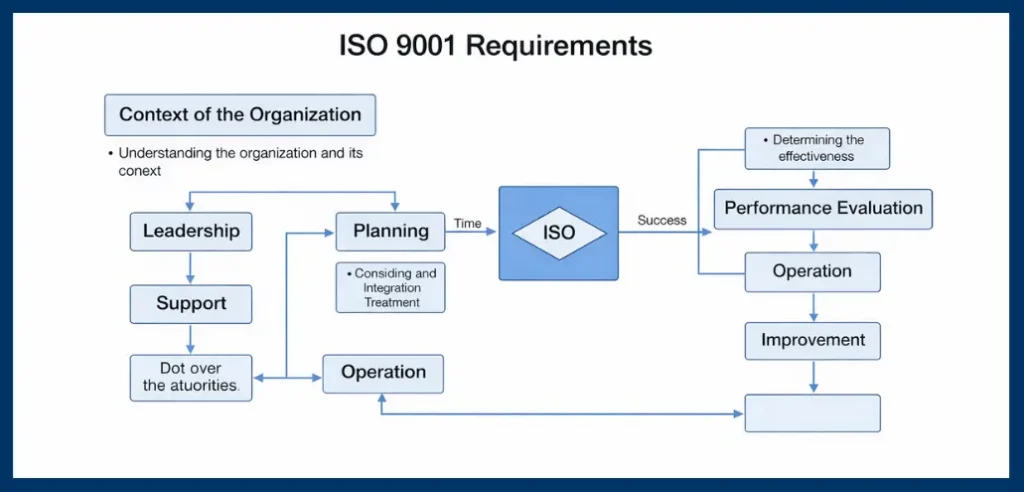
If you are searching for ISO 9001 requirements to win tenders, grow exports, or make your business system strong, you are at the right place. Many companies think about ISO only when a client asks for it. By that time, they may lose good chances. The real question is simple. Are your processes strong enough to face audits, big clients, and tough markets? In this guide, I explain ISO 9001 clauses and requirements in detail, so you can understand how the standard works and how it helps businesses build trust, control work, and improve quality every day.
What are the ISO 9001 Requirements?
ISO 9001 requirements are the rules given in the ISO 9001 standard that guide a company on how to build and manage a Quality Management System. These requirements help a business plan its work, do the work properly, check the results, and improve the system again and again, following the Plan–Do–Check–Act method. They help reduce mistakes, control processes, and improve customer satisfaction. Any small or large company can follow these rules. When an external auditor checks and confirms compliance, the company can receive ISO 9001 certification.
What is iso 9001 clauses?
ISO 9001 clauses are the ten important parts of the ISO 9001:2015 standard that show a company how to manage quality in a proper way. These clauses guide the company to plan its work, carry it out carefully, check if everything is working well, and then improve the system step by step.
10 Clauses of ISO 9001 Explained
This infographic explains all 10 clauses of ISO 9001:2015 for quality management.
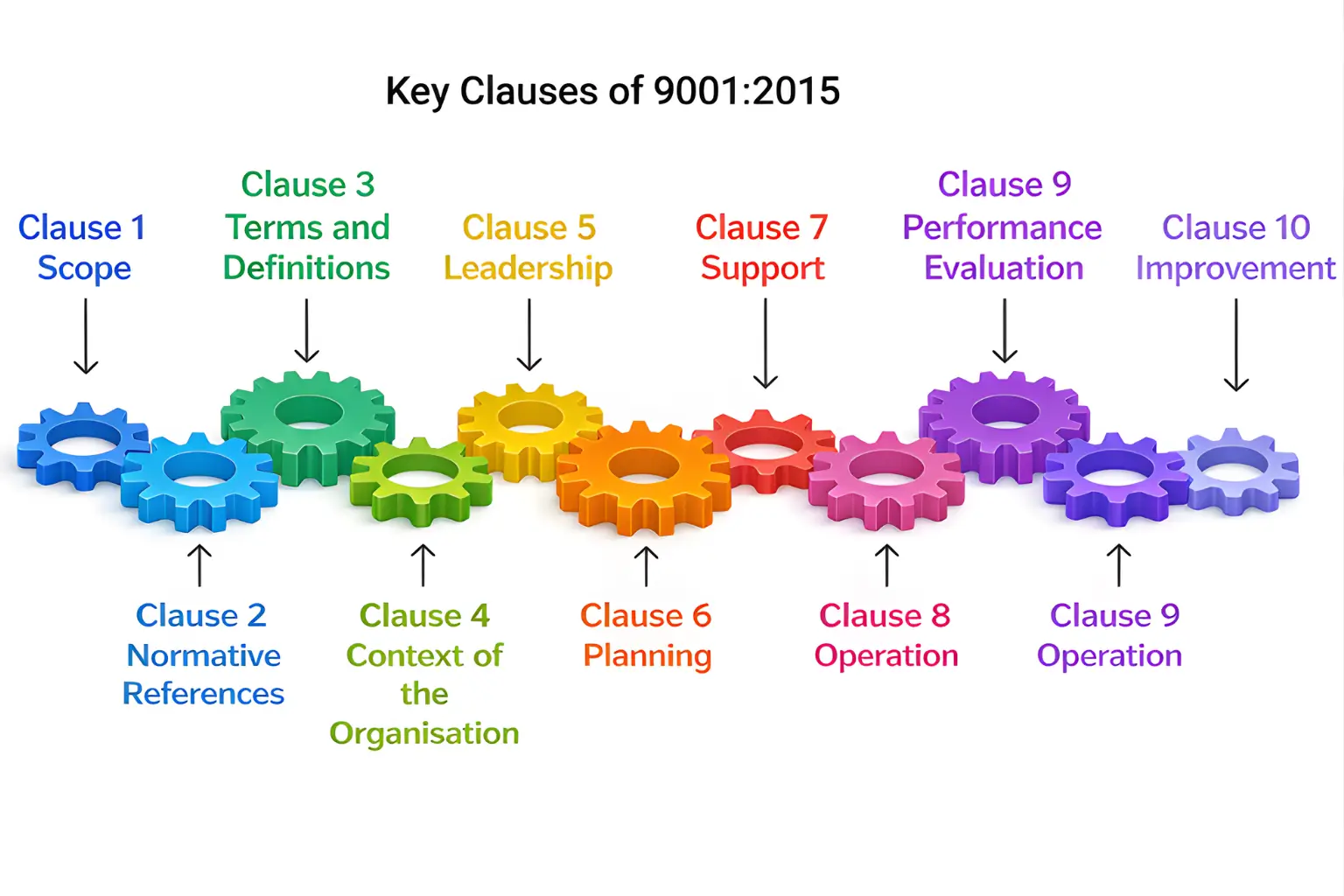
10 clauses of ISO 9001 explained for effective Quality Management System implementation.
Clause 1 – Scope: This clause explains why ISO 9001 is used and who can apply it. It tells that any small or large company can use this standard if it wants to give a steady quality and meet customer and legal requirements. This clause gives a simple overview of what the Quality Management System is about. The company’s exact QMS scope is explained later in Clause 4.
Clause 2 – Normative References: It explains that ISO 9001 depends on ISO 9000 for basic quality terms and definitions. ISO 9000 describes important ideas like quality, process, and improvement. This makes sure everyone understands the same meaning of the words used in the standard.
Clause 3 – Terms and Definitions: It explains important words used in ISO 9001, such as risk, process, and nonconformity. It makes sure everyone in the company understands these terms in the same way. When the meaning is clear, there is less confusion while building and running the Quality Management System.
Clause 4 – Context of the Organization: It tells the company to understand its current position before building the system. The business should review internal points like employees, skills, and how processes are performing. It should also check external points such as market conditions, customer expectations, competition, and legal requirements. The company must identify interested parties like customers, suppliers, owners, and authorities. After this review, it defines the scope of its Quality Management System and identifies its key processes and how they work together. This makes sure the system fits real business conditions and manages actual risks and opportunities.
Clause 5 – Leadership: This clause states that the top managers are responsible for the Quality Management System. They must make a clear quality policy that matches the company’s goals. They should tell everyone what their job and duty are. Managers must care about customer needs and think about risks before making decisions. When leaders are involved and show real support, workers understand the system and follow it properly in their daily work.
Clause 6 – Planning: It means the company must look at risks and also look for ways to improve. It should understand what might go wrong and what can help the business do better. The company needs to set clear quality goals that can be checked and measured. It must also make proper plans to reach these goals. If any change is needed in the system, it should be planned carefully. This helps avoid problems and keeps the company ready for future needs.
Clause 7 – Support: This means the company must have everything needed to run the Quality Management System. This includes trained workers, proper machines, tools, and a safe workplace. The company must also make sure people talk clearly and share the right information. It must control documents so that only the correct and updated papers are used. If support is weak, even a good plan will not work properly.
Clause 8 -Operation: This means the company must control its daily work. It should plan and manage how products are made or how services are given. The company must clearly understand what the customer wants. It should also check suppliers and any outside work. If something changes, it must handle it carefully. If a product or service has a problem, it must stop it before it reaches the customer. This helps give steady and good quality every day.
Clause 9 – Performance Evaluation: This means the company has to see if its quality system is working the right way. It should check its work steps and ask if customers are happy. The company must look at numbers and reports to understand the results. It has to do internal audits at planned times to see if rules are followed. Top managers must meet and talk about how the system is doing and decide what to improve. This helps find mistakes and make the system better.
Clause 10 – Improvement: In Clause 10, the company must correct problems and keep making the system better. If something goes wrong, the company should find the real reason and fix it so it does not happen again. The company should always try to improve its work, products, and services. Small improvements, again and again, keep the Quality Management System strong and help the business grow slowly and safely.
ISO 9001 Clauses List with Practical Meaning
The ISO 9001:2015 standard, published by the International Organization for Standardization, is rranged into a clear list of clauses. These clauses help organizations build and manage a strong Quality Management System in a step-by-step way. Each section guides the company in planning its work, doing the work properly, checking the results, and improving processes. This structure helps ensure steady quality and better customer satisfaction.
Name | Purpose | Why It Is Important |
Clause 1 – Scope | Tells where the Quality Management System applies | Helps set clear limits and avoids confusion |
Clause 2 – Normative References | Refers to other ISO standards like ISO 9000 | Helps understand basic terms and ideas |
Clause 3 – Terms and Definitions | Explains important quality words | Make sure everyone understands the same meaning |
Clause 4 – Context of the Organization | Looks at internal and external issues | Helps find risks, needs, and important people |
Clause 5 – Leadership | Makes top managers responsible for the system | Builds strong quality culture in the company |
Clause 6 – Planning | Finds risks and sets quality goals | Stops problems and keeps work focused |
Clause 7 – Support | Provides training, tools, and resources | Helps the system run smoothly |
Clause 8 – Operation | Controls daily work and processes | Ensures steady product or service quality |
Clause 9 – Performance Evaluation | Checks and reviews system performance | Finds problems and checks success |
Clause 10 – Improvement | Fixes problems and improves processes | Helps the company grow and improve step by step |
Why Organizations Follow ISO 9001 Requirements
Many companies follow ISO 9001 requirements to improve their daily work and get better results. These rules help control processes, reduce mistakes, and improve quality. When work is done in a clear and planned way, customers feel more satisfied. ISO 9001 also builds trust in the market and helps companies qualify for tenders and export work. Many organizations first implement the system properly and then apply for certification.
Main Benefits
- Improves daily operations
- Reduces errors and rework
- Increases customer satisfaction
- Builds market trust and credibility
- Helps with tenders and exports
- Supports steady business growth
Common Myths About ISO 9001
- Only for big companies, small and medium businesses can also use it
- Only for manufacturing, Service industries can benefit too
- Too complex – It becomes simple when followed step by step
- Only paperwork – It improves real business processes
- Not useful for small businesses – small companies gain structure and trust
ISO 9001 Certification with JS Certification
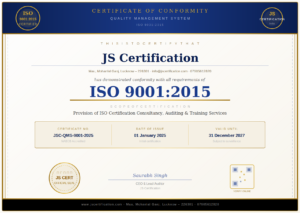
JS Certification makes ISO 9001 certification simple and easy for your business. Their expert team helps you build a strong Quality Management System (QMS) and guides you step by step through the entire process.
They review your current system, identify gaps, and support you with documentation, training, and audit preparation. Everything is explained clearly, so there is no confusion.
With a transparent process and globally recognized certificates, JS Certification helps you improve quality, build customer trust, and achieve ISO 9001 certification with confidence.
Conclusion
ISO 9001 requirements help a company create a strong and simple system to manage quality. When a business understands the ISO 9001 clauses and applies them step by step, daily work becomes clearer and more organized. Errors go down, customer confidence grows, and processes become better with time.
ISO 9001 is not just about getting a certificate. It is about building a system that works in daily operations. When used correctly, it helps the business grow steadily and perform better in the long run.