ISO 42001 Certification is becoming essential as Artificial Intelligence reshapes how organisations operate—improving efficiency, automating decisions, and driving innovation at an unprecedented scale. But with this rapid adoption come serious risks: algorithmic bias, data misuse, lack of transparency, inaccurate AI outputs, and unclear accountability. These challenges have pushed global regulators—including the EU AI Act and upcoming Indian AI governance frameworks—to demand structured and responsible AI management.
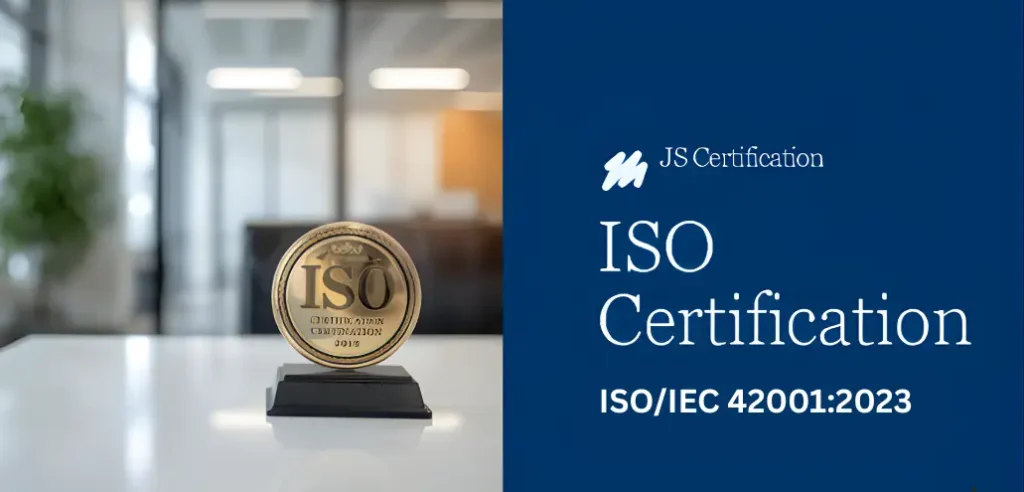
To address this, the International Organization for Standardization introduced ISO/IEC 42001:2023, the world’s first standard dedicated to Artificial Intelligence Management Systems (AIMS). It helps organisations design, develop, deploy, and monitor AI responsibly, ensuring fairness, transparency, and trustworthy outcomes throughout the AI lifecycle.
For Indian companies—including AI startups, SaaS platforms, IT/ITES providers, fintech firms, healthcare organisations, and manufacturing units adopting automation—ISO 42001 is becoming a competitive necessity rather than a choice.
What Is ISO/IEC 42001 (AIMS)? – Complete Explanation for Businesses
ISO/IEC 42001:2023 provides a structured management system to oversee AI operations across their entire lifecycle:
design → data → model training → deployment → use → monitoring.
The standard requires organisations to define clear controls around:
- Data governance
- Bias detection & mitigation
- Explainability & transparency
- Risk assessment
- Performance monitoring
- Security & privacy
- Third-party AI vendor assessment
In simple words, ISO 42001 ensures your AI behaves ethically, securely, and predictably.
Also Read: ISO 14001 is the global standard for Environmental Management Systems (EMS).
Who Needs ISO 42001?
This standard is crucial for organisations that:
- Develop AI models, ML algorithms, chatbots, or computer vision tools
- Use AI in HR screening, credit scoring, healthcare diagnosis, or business decisions
- Deploy AI in manufacturing, robotics, or quality control
- Manage customer data through AI-powered automation
- Use third-party AI vendors or APIs
- Work with global clients requiring proof of AI governance
- Want to comply with the EU AI Act or upcoming Indian AI policies
If your organisation uses or depends on AI—even partially—ISO 42001 applies to you.
Key Requirements of ISO/IEC 42001
1. Establishing an AI Management System (AIMS)
A structured governance framework that documents policies, roles, responsibilities, controls, and monitoring methods for all AI systems.
2. AI Risk Assessment & Controls
ISO 42001 identifies key AI-specific risks such as:
- Algorithmic bias
- Model drift
- AI hallucinations
- Data poisoning
- Lack of explainability
Organisations must evaluate and mitigate these risks at every stage.
3. Ethical & Transparent AI Principles
The standard emphasises:
- Fairness
- Accountability
- Human oversight
- Traceability
- Explainability
These principles help organisations build trustworthy models.
4. Continuous Monitoring & Improvement
AI is not a “build once and forget” system. ISO 42001 requires ongoing audits, model evaluations, data reviews, and impact assessments.
5. Third-Party AI Governance
When using external AI solutions, organisations must ensure vendors follow ethical practices and regulatory standards.
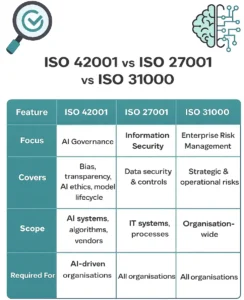
ISO 42001 vs ISO 27001 vs ISO 31000 – Comparison Table
| Feature | ISO 42001 | ISO 27001 | ISO 31000 |
| Focus | AI Governance | Information Security | Enterprise Risk Management |
| Covers | Bias, transparency, AI ethics, model lifecycle | Data security & controls | Strategic & operational risks |
| Scope | AI systems, algorithms, vendors | IT systems, processes | Organisation-wide |
| Required For | AI-driven organisations | All organisations | All organisations |
Also Read: ISO 9001 Certification is one of the most well-known international standards.
How ISO/IEC 42001 Solves Real-World AI Challenges
✔ AI Bias & Explainability
Companies must evaluate models for fairness and ensure decisions can be explained to auditors, regulators, and customers.
✔ Security & Intellectual Property Protection
ISO 42001 provides controls to protect training data, model integrity, and proprietary algorithms.
✔ Continuous Learning & Model Drift
Machine learning models evolve over time. Monitoring ensures accuracy and prevents unintended consequences.
✔ Vendor & Third-Party AI Management
Most organisations rely on external AI tools. ISO 42001 ensures these systems meet your compliance standards.
ISO 42001 Operational Framework: Plan → Do → Check → Act
Plan: Define scope, identify risks, and create an ethical AI policy.
Do: Implement governance controls, ensure transparency, and prepare documentation.
Check: Audit models, evaluate risks, and assess ongoing compliance.
Act: Improve systems, update policies, and respond to regulatory changes.
This ensures your AI remains reliable and compliant at all times.
Certification Process for ISO/IEC 42001
1. Initial Gap Assessment
Check what your company is currently doing with AI and compare it with what ISO/IEC 42001 requires. This helps you understand what is missing.
2. Planning & Project Initiation
Make a clear plan for how you will meet the ISO 42001 requirements. Decide who will handle each task.
3. Documentation Development
Create all the necessary documents, such as policies and procedures, that explain how your AI system will work safely and responsibly.
4. Implementation of AIMS Controls
Start using the AI processes and safety controls that you wrote in the documents. This means putting the plan into action.
5. Internal Audit
Your internal team checks if everything is being done correctly and finds areas that need improvement.
6. Management Review
The top managers look at the audit results and overall system performance to make decisions and improvements.
7. Stage 1 Audit
The certification body reviews your documents to see if you are ready for the final audit.
8. Stage 2 Audit
Auditors visit your company to check if all AI controls are actually being followed and working effectively.
9. Certification Decision
If everything meets the ISO 42001 standard, the certification body approves and gives you the certificate.
10. Surveillance Audits
Every year, auditors check again to make sure your AI processes are still being followed and improved.
11. Recertification Audit
Every three years, a full review is done to renew your ISO 42001 certificate.
Benefits of ISO/IEC 42001: Why Businesses Should Act Now 
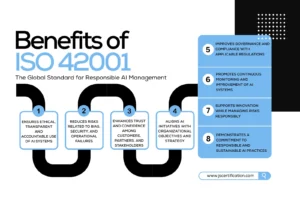
- Ensures trustworthy & transparent AI
- Boosts customer confidence
- Supports global compliance (EU AI Act, DPDP Act, GDPR)
- Mitigates legal & financial risks
- Helps secure international clients
- Improves operational efficiency
- Strengthens data & AI security
- Enhances brand reputation
- Creates accountability and human oversight
With global AI regulations accelerating, early adopters will gain a strong competitive edge.
Conclusion: Build Responsible & Compliant AI with ISO 42001
AI is now the backbone of digital transformation, but without a proper governance framework, it can expose organisations to ethical, operational, and legal risks. ISO 42001 Certification provides a robust management structure to ensure AI systems remain ethical, transparent, secure, and fully compliant with global standards. Implementing ISO/IEC 42001 positions your organisation as a leader in responsible AI deployment and prepares you for the rising global demand for regulated and trustworthy AI systems.
If your organisation requires expert assistance in preparing documentation, implementing AIMS, or obtaining ISO/IEC 42001 certification, JS Certification can guide you through every step of the process.
FAQ
Q1. What is ISO 42001 certification?
ISO 42001 is the global standard for managing AI systems responsibly, ensuring safety, transparency, and compliance.
Q2. Who needs ISO 42001 certification?
Any organisation that builds, deploys, or uses AI systems—including tech companies, SaaS, finance, healthcare, manufacturing, and government bodies.
Q3. What are the requirements of ISO 42001?
It requires a structured AI management system, risk assessment, transparency, lifecycle control, monitoring, and ethical AI practices.
Q4. How long does ISO 42001 certification take?
On average, 2–6 months, depending on your system complexity, documentation, and readiness.
Q5. Why is ISO 42001 important?
It helps organisations reduce AI risks, prevent bias, meet regulatory requirements, and improve trust in AI.